/* Sitemap plugin By MyBloggerLab */ #bp_toc { color: #666; margin: 0 auto; padding: 0; border: 1px solid #d2d2d2; float: left; width: 100%; } span.toc-note { display: none; } #bp_toc tr:nth-child(2n) { background: #f5f5f5; } td.toc-entry-col1 a { font-weight: bold; font-size: 14px; } .toc-header-col1, .toc-header-col2, .toc-header-col3 { background:#9E9E9E; } .toc-header-col1 { padding: 10px; width: 250px; } .toc-header-col2 { padding: 10px; width: 75px; } .toc-header-col3 { padding: 10px; width: 125px; } .toc-header-col1 a:link, .toc-header-col1 a:visited, .toc-header-col2 a:link, .toc-header-col2 a:visited, .toc-header-col3 a:link, .toc-header-col3 a:visited { font-size: 13px; text-decoration: none; color: #fff; font-weight: 700; letter-spacing: 0.5px; } .toc-header-col1 a:hover, .toc-header-col2 a:hover, .toc-header-col3 a:hover { text-decoration: none; } .toc-entry-col1, .toc-entry-col2, .toc-entry-col3 { padding: 5px; padding-left: 5px; font-size: 12px; } .toc-entry-col1 a, .toc-entry-col2 a, .toc-entry-col3 a { color: #666; font-size: 13px; text-decoration: none } .toc-entry-col1 a:hover, .toc-entry-col2 a:hover, .toc-entry-col3 a:hover { text-decoration:underline; } #bp_toc table { width: 100%; margin: 0 auto; counter-reset: rowNumber; } .toc-entry-col1 { counter-increment: rowNumber; } #bp_toc table tr td.toc-entry-col1:first-child::before { content: counter(rowNumber); min-width: 1em; min-height: 3em; float: left; border-right: 1px solid #fff; text-align: center; padding: 0px 11px 1px 6px; margin-right: 15px; } td.toc-entry-col2 { text-align: center; }
Showing posts with label Immunity. Show all posts

Tuesday, 3 May 2016

Training Talk: What Female Athletes Need to Know About Fueling Their Bodies


At the 10th Annual Sanford Sports Medicine Symposium last weekend, I spoke about nutrition's role in injury prevention and recovery. One of the main topics of the presentation was low energy availability in athletes. Energy availability is the amount of calories left over for the body to use for normal physiological functions (heart beating, walking around, lungs breathing, thermoregulation, growth, etc.) after accounting for calories burned during training or exercise.

Food intake - Energy Expended During Exercise = Energy Availability


Athletes who have heavy training schedules can be living in a chronic state of low energy availability, where every calorie they eat at meals is burned off during exercise, leaving little to no calories for the body to perform those regular bodily functions.

When calorie intake doesn't match energy expenditure, this low energy availability can not only have negative effects on training and athletic performance, but can put athletes at risk for other health problems.

For female athletes, this low energy availability can lead to other health issues, such as low bone mineral density and menstrual function disorders in what is called the Female Athlete Triad. Physically active girls and women can experience any one of the 3 components, which are interrelated and occur along a spectrum of healthy to unhealthy (see picture below).
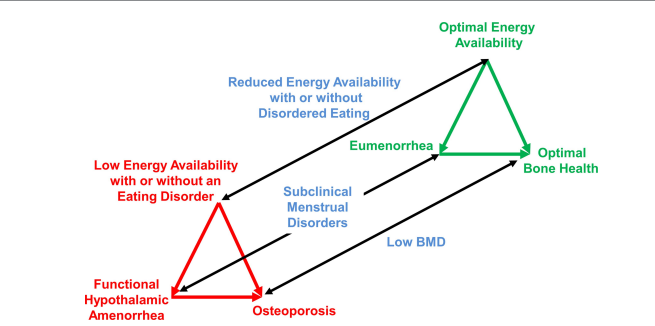
Source: 2014 Female Athlete Triad Coalition Consensus Statement on Treatment and Return to Play of the Female Athlete Triad.
De Souza MJ, et al. Br J Sports Med 2014;48:289
Female athletes won't always know the signs of female athlete triad because they won't necessarily lose weight if they have low energy availability (many athletes have a stable weight despite not meeting their calorie needs)...but they might notice if  they're training hard and lose their menstrual period. An estimated 20% of active women has missed 3 or more consecutive menstrual periods, called amenorrhea. This can lead to a loss of calcium from bones, a much higher incidence of stress fractures and poor bone health...but some athletes might believe that losing their period is just a normal part of hard training.

Regardless of body fat and weight, athletes' low energy availabliy can trigger amenorrhea, and appropriate treatment depends on why the athlete is under-fueling.

  • Unintentional fueling due to low appetite from heavy training, or they may have a hard time fitting in meals and snacks around a heavy training schedule. 
  • Some athletes are caught up in the diet culture of their sport (or society in general), trying to lose weight, with the goal of being better at their sport. They may take this too far and develop disordered eating habits, restricting intake of foods such as carbohydrates or animal protein, which can cause under-fueling and nutrient deficiencies. 
  • Some athletes' restrictive eating patterns and disordered eating can lead to eating disorders, which puts athletes at a greater risk for health problems, and requires a different approach to recovery. 

Treatment of female athlete triad requires correcting the energy imbalance - increasing calorie intake and resting from exercise. 

Female athletes are often surprised when they find out how many calories they need to be eating to fuel their bodies, and how few they are currently eating. Very active individuals usually need at least 3 meals and several snacks per day. To get a better idea of current intake, athletes can track their food using popular apps, such as MyFitnessPal or tools like the SuperTracker.

Although these tools give athletes an idea of what they're doing now, working with a registered dietitian can take the guess work out of meal planning and give them more guidance to how many calories they really need to support training, and which foods they should be focusing on to really optimize their workouts and recover properly.

The total calories aren't the only thing that matter - girls and women can be deficient in several key nutrients:

  • Vitamin D: spend more time outdoors, fortified breakfast cereal, milk, fatty fish like salmon, egg yolks or a vitamin
  • Calcium: dairy such as milk, cheese, yogurt
  • Iron: it's important to get screened for iron status, as many women, especially endurance athletes, tend to have low iron
  • Healthy fats: focus on eating plenty of nuts (including peanut/almond butter!), seeds (flax, hemp, chia), olive oil, avocados, salmon
  • Adequate protein: 20-25 grams per meal, 10-15 grams per snack in the form of lean protein (chicken, fish, lean beef), nuts, yogurt, milk, beans, peas and soy
  • Energy-enhancing carbohydrates: the amount of carbs an athlete needs depends on their weight and what kind of sport they're in, but because carbs are our muscles' main fuel source, eating plenty of fruit, vegetables, whole grains, and potatoes is necessary to perform well and recover adequately. 

When speaking with female athletes, it's important to emphasize that food is fuel!

It's a good thing to eat when you're hungry and to enjoy food.  Eating more food doesn't necessarily equate to weight gain, and many times, it can actually lead to improved sport performance. If an athlete or parent of an athlete suspects they are having any of the issues discussed, they should talk to their doctor. There are other causes for amenorrhea, so it's important to consult with your doctor to rule out other causes! A Registered Dietitian can help athletes fuel their bodies properly to avoid issues related to female athlete triad and under-fueling for their sport.


NPR || To Thrive, Female Athletes Need a Lot More Food

The Informed Appetite || Drink Milk, or Don't. But Maybe Read This First (#Science!)

New York Times || After 'The Biggest Loser,' Their Bodies Fought to Regain Weight

Yeah...Imma Eat That || The Hunger and Fullness Scale (AKA How to Stop Dieting)


Tuesday, 1 December 2015

How To Boost Your Immune System (All Year Long!)


We've all had those days where you can just feel a cold coming on. Eyes watering, nose running, coughing, sneezing, and feeling headache, you head over to the nearest grocery store to pick up some orange juice, soup and medicine. If you're an athlete, you might even think, "I wonder if I can still go to practice...?" or "I'll just wait for this cold medicine to kick in before I go running..."

Being sick can not only force you to take days off from school or work, but can also put a kink in your training schedule if your cold or flu lingers for days...or even weeks. If you push too hard while you're sick, you can risk even worse illness or injury.

Sometimes, you can't control getting sick, and popping vitamin C capsules probably won't help you kick a cold once you have it, but you can promote a healthier immune system throughout the year by consistently fueling your body with the foods it needs - use these 5 guidelines for more info:

1. Avoid under-eating or over-exercising

It is easy for athletes to get caught up in a training schedule, neglecting those rest days and proper nutrition. If you're not meeting your calorie needs and every single one of your workouts get your heart working at its max, your stress hormones will increase and you're going to be at risk for over-training, injury, and a weakened immune system. 

Any good training program will have rest days built in - they're there for a reason. Make your hard days hard, your easy days easy, and make sure your weight is consistent. If you start to lose more than 1 lb. per week or you're feeling weak or easily fatigued, you may not be eating enough calories to support your training. Weight loss goals are met during the off-season, so if you're trying to meet your weight loss goals during training, you may not be getting enough calories in to push your body on those hard training days. 

Not sure how many calories you need to eat to support your training or weight loss/gain goals? Call the Sanford Sports Science Institute at 605-312-7870 to schedule an appointment to get your Resting Energy Expenditure tested. 

2. Get enough sleep

A recent study showed that people with shorter sleep duration (under 6 hours per night) had an increased susceptibility to the common cold. Sleep should be an integral part of any athlete's training schedule. While you sleep, you give your muscles a chance to rest and rebuild. 


If your sleeping pattern is erratic or you're not getting at least 7-8 hours of sleep each night, you're not giving your body the rest it needs to recover. Your stress hormone cortisol increases, which can delay recovery after exercise. There is also an increase in ghrelin and decrease in leptin, two hormones that affect your hunger - in this case, by making you feel hungrier than normal. In addition, when you're sleep deprived, your immune system doesn't work as hard to fight off illness. 

The combination of delayed recovery, increased hunger (which can lead to overeating and weight gain) and decreased immune system functioning can be bad news for athletes during training. Make sure you're making sleep a priority - your sleep schedule should be considered just as important as your training schedule and your nutrition. 

3. Eat 5 or more servings of vegetables and fruits per day

...and we're not talking about potatoes, corn, or peas. You should be eating a serving of vegetables and/or fruits at each meal and snack, and the more color you have on your plate, the more immune-boosting vitamins and minerals you're getting in your diet. 

Some colorful foods you should be eating include: carrots, green leafy vegetables like spinach and kale, berries like strawberries and blueberries, citrus fruits such as oranges and grapefruit, bell peppers, sweet potatoes, winter squash and apples. Eating more fruits and vegetables increases your supply of inflammation-fighting, immune-boosting vitamins and minerals, so the more you eat, the better your body can recover after exercise or hard training. 

4. Jump-start recovery after exercise

After high intensity or long duration (>90 minute) workouts, athletes should eat a post-workout snack with 2:1 to 3:1 ratio of carbs to protein to refuel muscle glycogen (energy) and help promote muscle healing and growth. By doing this, your body can start to recover right away so you can start your next workout refueled and feeling energized. 

Good examples of this snack are chocolate milk, Greek yogurt with berries and granola, a banana with peanut butter, a peanut butter and jelly, rice with chicken and vegetables, a smoothie, etc. Make sure to eat periodically throughout the day (don't skip meals) to make sure your body has the building blocks it needs to build muscle and store carbohydrates away as glycogen to use in your next workout.

5. Give your gut some attention

You may have heard that 50-70% of your immunity comes from your stomach, so making sure your gut is healthy is vital to boosting your immune function. Check out a previous blog post on promoting good gut health for some more ideas, and include more of these foods in your diet:

Probiotics (good gut bacteria)

Yogurt or kefir with live and active cultures, probiotic supplements, kimchi, sauerkraut

Prebiotics (promote the health of good gut bacteria)

Asparagus, garlic, leeks, onions, beans, whole grains, potatoes


If you want to know more about boosting your immune system through food, call the Sanford Sports Science Institute to make a one-on-one appointment with the sports nutritionist: 605-312-7878.


You may also like:


Tuesday, 13 October 2015

The Secrets to a Healthy Gut


Bacteria have a bad reputation, especially during the fall and winter seasons, when everyone around you seems to be coming down with the flu or a cold. Many athletes during this season might be increasing their training volume and are looking for a little extra immune support. 


 While it's true you'll want to wash your hands more often to prevent the spread of bacteria that cause illness, this can also be a good time to focus your attention on increasing your relationship with good bacteria. It has been estimated that your body has fewer human cells than bacteria. With about 10^14, (that's 100,000,000,000,000 bacterial cells!), your body acts as a host to many bacteria, including GOOD bacteria found in your gut, which can actually help you boost immunity and overall health.

The profile of your gut bacteria (gut microbiota) can promote health by: 
  • boosting the immune system
  • secreting antimicrobial substances that prevent bad bacteria from colonizing and making us sick
  • helping with digestion
  • producing vitamins (B-vitamins and Vitamin K)
Maybe you've heard that taking a probiotic supplement or eating certain yogurt brands can be healthy, but you might not know why. Probiotics are live micro-organisms, which, when administered in adequate amounts, confer a health benefit to the host. These are the good bacteria that deserve your attention - you want a healthy population of good gut bacteria in your body. The profile of these bacteria is affected by age and antibiotic use, but is also affected by things you can control, like stress levels and the things you eat. For instance, eating more probiotics may increase the population of good bacteria. 

Most of the good bacteria or probiotics you'll hear about come from the Lactobacillus species and/or the Bifidobacteria species, but there's also different strains/types of the bacteria, and varying doses/amounts found in foods or a supplement. Many of the doses found in foods are pretty low compared to supplement forms, which can contain billions of Colony Forming Units (CFU's). 

Although many research studies are inconclusive on the specific strain and dose of bacteria that is most beneficial, and whether or not food or supplement forms of probiotics are best for your gut health, there are many ways you can promote good gut health that are good for your overall health regardless of their probiotic content!

1. Focus on prebiotics. Yes, you read that right - probiotics feed on prebiotics in your diet (indigestible ingredients like fructo-oligosaccharides (FOS) and inulin that the bacteria in your gut feed on). Prebiotics, are found in fruits, vegetables and whole grains like oatmeal or brown rice, so  eating a wide variety of these plant-based foods (especially onions, bananas, artichokes, asparagus, barley and garlic), will help keep your gut bacteria healthy.

2. Eat fermented foods. Food such as yogurt, kefir, fermented vegetables like sauerkraut, kimchi, miso, and tempeh are good sources of probiotics. By eating these foods, which contain live/active cultures, you can promote a healthy population of your own gut bacteria.

3. Reduce your stress level. Go for a walk, take a yoga class, wash the dishes, write in a journal - there are many ways to reduce stress levels. When we're stressed out, we may have GI issues such as an upset stomach or frequent bowel movements, or we may choose less healthy, comforting foods, both of which aren't healthy to our gut bacteria. 

Focusing on these three strategies is not only good for overall health, it will help you promote a healthier population of gut bacteria, which can be immune-boosting and benefit your health. 


What about supplements?


You will find a lot of products or supplements in the supermarket that advertise their probiotic benefits, but taking a "foods first" approach to increase the probiotics in your diet is a great way to reap the benefits of those healthy foods (such as getting a healthy dose of protein from the yogurt or tempeh) without spending additional money on supplements. Again, most studies agree that eating probiotics is likely beneficial (even if research isn't conclusive on the most beneficial dose or strains of bacteria of whether foods or supplement forms are better). 

Food sources of probiotics (like the fermented foods listed above) have been around for thousands of years and contain many other beneficial vitamins and minerals. That alone makes  these foods worthy of including in most diets, whether they're advertising their probiotic benefits or not


A dietitian can help you navigate the options if you are thinking about including healthful probiotic-rich foods in your diet!

What foods should I be looking for?

The dietitians picks:

Greek yogurt (Choose plain yogurt and add your own honey or chopped fruit)


Kefir (Again, choose plain and blend it into smoothies. It is quite tart, so mixing it into smoothies is a great way to sweeten it up!)


Tempeh (If you've never tried it - check out this article from the Kitchn).

Kimchi and Sauerkraut  (Look for refrigerated varieties. Canned versions will have cooked and killed the live bacteria).

Do you eat any fermented foods?

More articles on this topic:
------------------------------------------------------------------------

Nutrition Stripped || Guide to Probiotics

EatRight.Org || Probiotics and Prebiotics: Creating a Healthier You

NCAA/SCAN || Foods to Promote Immune Function